Dana Carter · 4 November 2026
Branching Pathways Influence Efficiency Metrics Across Hierarchical Data Networks During Infrastructure Shifts
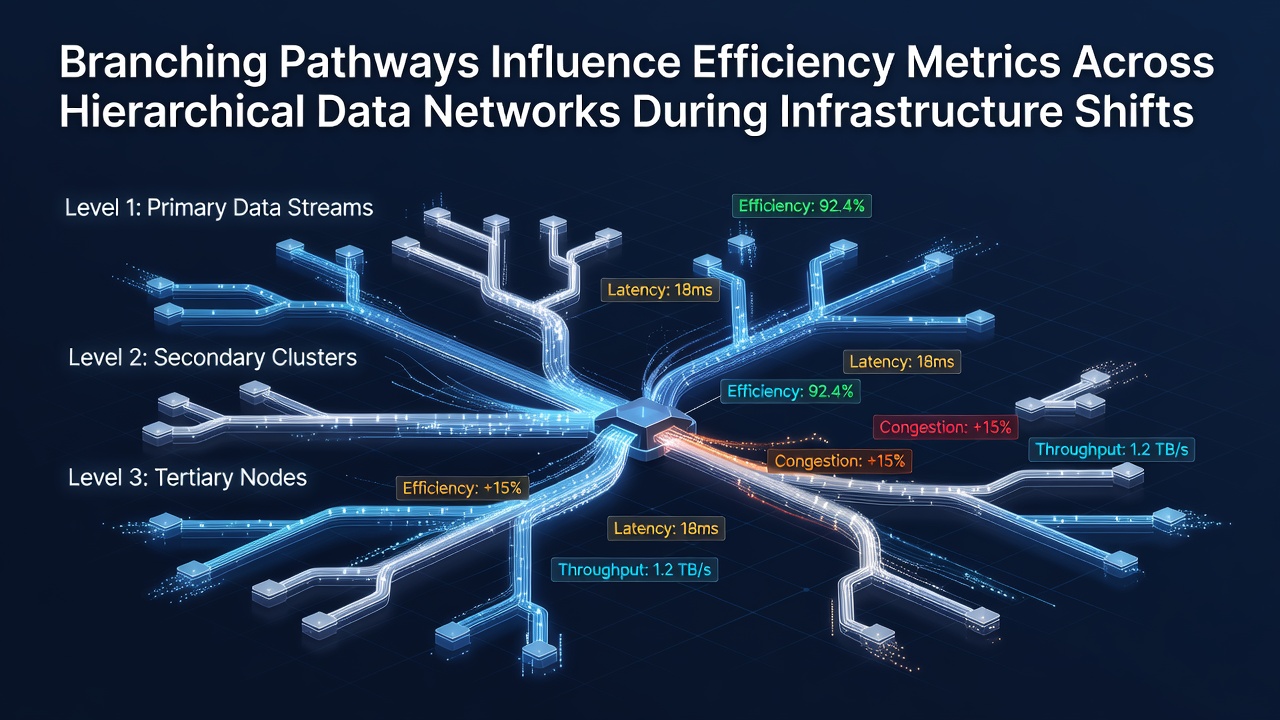
Branching pathways determine how data moves through layered network structures, and their configuration directly shapes efficiency metrics such as throughput, latency distribution, and resource utilization during infrastructure shifts. Hierarchical data networks organize nodes into levels where upper tiers manage aggregation while lower tiers handle distribution, and any change in branching alters the flow patterns that those metrics track.
Network Structures and Pathway Dynamics
Hierarchical setups rely on parent-child relationships that route traffic through designated branches, and observers note that even minor adjustments in branch selection can redistribute load across multiple layers. Studies from research institutions show that branching decisions influence packet forwarding rates, with data indicating measurable differences in how quickly information reaches end nodes when pathways diverge at aggregation points.
During infrastructure shifts, teams often reconfigure these branches to accommodate new hardware or routing protocols, and the process requires careful mapping because each alteration affects downstream efficiency calculations. Figures from network monitoring tools reveal that pathway changes can produce shifts in overall system balance, particularly when multiple branches compete for shared bandwidth at convergence points.
Measuring Efficiency Under Transition Conditions
Efficiency metrics in these environments include average transmission time, energy consumption per data unit, and the ratio of successful deliveries to total attempts, all of which respond to branching modifications. Researchers at the National Institute of Standards and Technology have documented how pathway branching influences these values, especially when networks undergo phased upgrades that introduce temporary parallel routes.
One study revealed that networks with deeper branching hierarchies experienced different efficiency patterns compared to flatter designs during similar shifts, because additional decision points at each level compound small variations in routing choices. Data collected across multiple installations shows that metrics stabilize once new branches reach equilibrium, yet the transition period itself produces distinct temporary profiles that operators track through continuous sampling.
Observed Patterns in Recent Infrastructure Projects
Projects completed in late 2025 and extending into November 2026 demonstrated how branching adjustments aligned with scheduled hardware replacements produced measurable changes in efficiency readings. Australian research groups tracking large-scale data centers reported that networks incorporating adaptive branching algorithms maintained steadier metric performance while legacy paths were decommissioned.
Those findings align with observations from Canadian academic teams, which examined hierarchical systems in high-density environments and found that selective branch pruning reduced unnecessary duplication without compromising delivery rates. The patterns hold across different geographic regions because the underlying principles of layered routing remain consistent regardless of specific equipment vendors involved.

Factors That Shape Metric Responses
Branch length, redundancy levels, and the presence of cross-links between tiers all contribute to how efficiency metrics evolve when infrastructure changes occur. Longer branches tend to introduce cumulative delays that appear in latency distributions, whereas shorter branches concentrate traffic and can elevate utilization percentages at specific nodes. Network operators adjust these variables during shifts to keep overall performance within acceptable ranges, and monitoring platforms capture the resulting metric trajectories in real time.
Evidence from multiple deployments indicates that the timing of branch activation plays a role as well, since simultaneous activation of several new pathways can create transient congestion that older single-path configurations avoid. Teams therefore sequence changes to allow each branch to stabilize before introducing the next, a practice that data logs show preserves smoother metric transitions throughout the upgrade window.
Integration With Existing Monitoring Systems
Modern monitoring platforms integrate branching pathway data directly into efficiency dashboards, allowing continuous comparison against baseline values established before any infrastructure shift begins. This integration helps identify which branches contribute most to metric fluctuations, and analysts use those insights to prioritize subsequent adjustments. Reports compiled through 2026 confirm that such integrated views reduce the time required to reach steady-state performance after major reconfigurations.
Conclusion
Branching pathways exert clear influence over efficiency metrics in hierarchical data networks whenever infrastructure shifts take place, and the relationships appear consistently across documented cases. Continued collection of pathway-specific data supports more precise planning for future transitions, with results from various research sources providing reference points for organizations managing similar environments.