Bianca Hartmann · 21 October 2026
Scaling Challenges in Decentralized Network Architectures for High-Density Data Environments
Decentralized network architectures face mounting pressure when handling high-density data environments where thousands of nodes process continuous streams from sensors, devices, and applications simultaneously. Researchers have documented how these systems encounter bottlenecks in throughput, latency, and resource allocation that centralized alternatives often sidestep through direct control. Data from multiple studies shows transaction volumes can spike dramatically during peak periods, forcing architects to reconsider sharding strategies and peer selection algorithms that once seemed adequate.
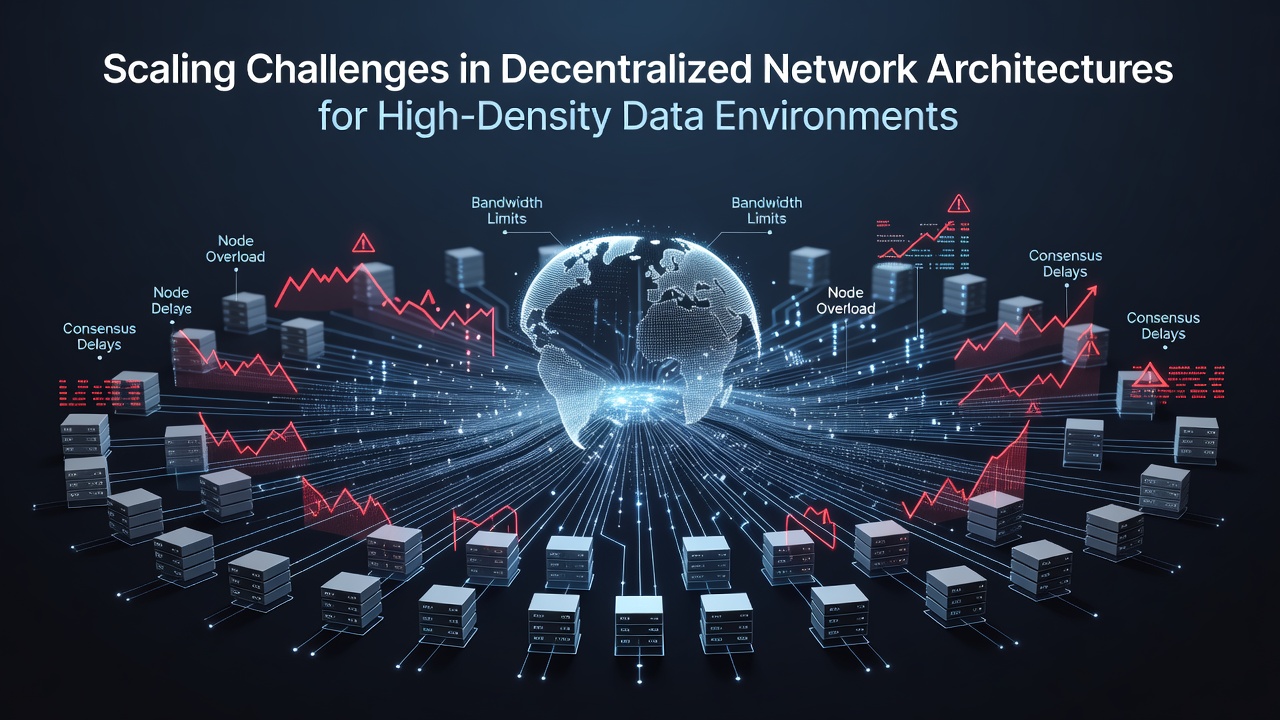
Network topology plays a central role in these limitations because dense data clusters create hotspots where bandwidth saturates quickly. Observers note that uneven node distribution leads to longer paths for data packets, and this compounds when devices enter or leave the network at high rates. Studies conducted through 2025 revealed average latency increases of 40 percent in topologies exceeding 10,000 active participants, prompting several research groups to test dynamic rerouting protocols that adapt in real time.
Consensus Overhead in Dense Deployments
Consensus protocols such as proof-of-stake variants and practical Byzantine fault tolerance encounter exponential growth in message exchanges as participant counts rise. Engineers have measured how each additional node multiplies communication rounds, and this scaling curve becomes especially steep once data density pushes transaction sizes beyond a few kilobytes. Figures from academic simulations indicate that certain algorithms require more than 200 milliseconds per block confirmation when node density reaches levels common in urban IoT deployments.
But here's the thing: many existing implementations still rely on gossip-based dissemination that works well in sparse settings yet floods links under concentrated loads. Teams working on protocol upgrades have begun experimenting with hierarchical validation layers that delegate verification to regional subgroups, and early results suggest measurable reductions in overall overhead without sacrificing finality guarantees.
Data Replication and Storage Pressures
High-density environments demand rapid replication across geographic boundaries to maintain availability, yet each copy multiplies storage requirements and synchronization traffic. Research indicates that systems storing sensor streams at sub-second granularity can exhaust available disk space on edge nodes within hours unless aggressive pruning or tiered retention policies are applied. One study revealed that replication factors above three often produce diminishing returns in fault tolerance while driving bandwidth consumption upward by multiples of the original data rate.

Storage tiering has emerged as a practical response because cold data can migrate to slower, cheaper layers while hot data remains accessible on high-performance nodes. Developers have implemented content-addressable schemes that allow deduplication across replicas, and this approach has lowered aggregate storage needs in several production networks tracked through mid-2026. The reality is that balancing consistency models with these efficiencies requires careful tuning of conflict resolution rules that operate without central arbitration.
Security Implications Under Scale
Attack surfaces expand when node counts and data volumes grow together because adversaries gain more entry points for eclipse attacks or targeted flooding. Reports from security researchers highlight how high-density clusters can mask malicious traffic within legitimate flows, delaying detection by monitoring systems calibrated for smaller networks. Evidence from incident analyses shows that recovery times after partition events lengthen considerably once thousands of nodes must re-establish trust relationships and re-sync state.
Regulatory bodies in different regions have started examining these risks more closely. The National Institute of Standards and Technology published updated guidance in 2025 on resilience testing for distributed ledgers, while the Australian Research Council funded projects exploring cryptographic methods that scale verification workloads more efficiently.
October 2026 Developments and Ongoing Research
As of October 2026 several testbeds have reported incremental gains from hybrid approaches that combine sharding with adaptive sampling of network conditions. These efforts demonstrate that selective data aggregation at the edge can reduce the volume of information that must traverse the full decentralized mesh. Observers tracking these deployments note that performance metrics improve most when sampling intervals align with expected data arrival patterns rather than fixed schedules.
Yet challenges persist around cross-shard transactions and state consistency when density fluctuates rapidly. Teams continue refining incentive mechanisms that encourage nodes to host data shards proportionally to their capacity, and this work draws on both theoretical models and measurements from live networks.
Conclusion
Scaling decentralized architectures for high-density data environments requires coordinated advances across topology management, consensus design, storage optimization, and security monitoring. Data collected through 2026 shows measurable progress in targeted areas while underscoring that no single technique resolves all constraints at once. Continued experimentation across academic, industry, and standards organizations will determine how effectively these systems accommodate growing data densities without compromising the core properties of decentralization.