Bianca Hartmann · 18 November 2026
Synchronization Protocols and Their Relation to Tremesh Configurations in Dynamic Node Setups
Network engineers have documented how synchronization protocols manage timing and data consistency across distributed systems, while tremesh configurations provide the structural backbone for connecting nodes that change positions or states over time. These elements work together in setups where nodes join or leave clusters without fixed topologies, and research from institutions such as the National Institute of Standards and Technology has outlined protocols that align clock signals to within microseconds.
Core Components of Synchronization Protocols
Protocols like Precision Time Protocol and Network Time Protocol operate by exchanging timestamped messages between nodes, and they adjust for latency through algorithms that calculate round-trip delays. In dynamic environments nodes must recalculate offsets frequently because movement alters signal paths, yet data from field tests shows that hybrid approaches combining hardware timestamps with software corrections maintain accuracy even when topology shifts occur every few seconds.
Observers note that these protocols also handle phase alignment, which prevents data packets from arriving out of sequence, and they integrate error-correction mechanisms that flag discrepancies before they propagate through the mesh. Studies conducted at technical universities in Canada have measured synchronization drift in mobile node clusters and found that periodic recalibration cycles reduce cumulative errors by factors of ten or more compared with static schedules.
Tremesh Configurations Explained
Tremesh setups arrange nodes in overlapping tree-like structures that adapt when individual units relocate or experience signal loss, and configuration files define parent-child relationships along with fallback routes. Engineers deploy these configurations in environments such as sensor arrays or vehicle fleets where connectivity changes constantly, and configuration management tools push updates to nodes through the same channels used for data exchange.
Configuration parameters include hop limits, redundancy factors, and priority weights that determine which nodes act as timing masters during transitions. Reports from European research consortia indicate that tremesh layers built on top of standard routing protocols allow networks to recover from node failures in under 200 milliseconds when synchronization remains intact.
Integration in Dynamic Node Environments
When synchronization protocols feed timing data into tremesh configuration engines, nodes can coordinate state changes more effectively because each participant shares a common reference clock. This integration becomes essential in scenarios where nodes must hand off responsibilities without interrupting ongoing data streams, and algorithms embedded in the protocols trigger configuration adjustments based on observed jitter thresholds.
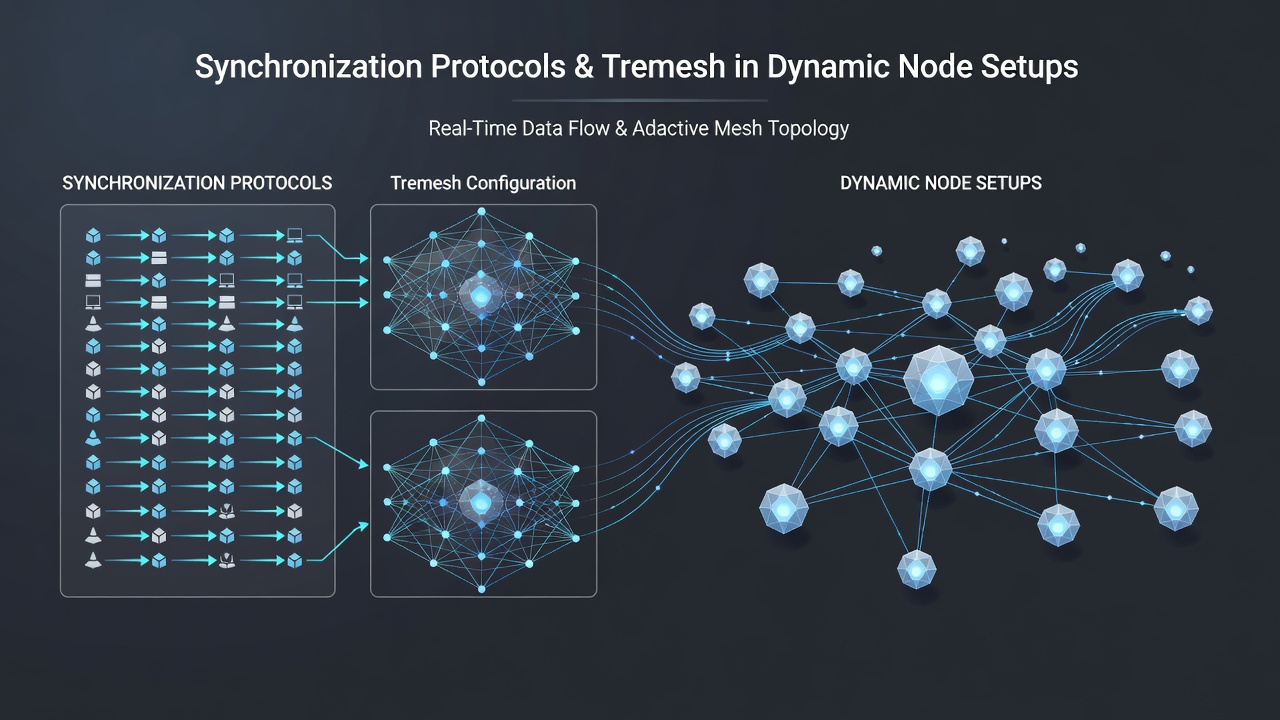
Systems deployed in industrial monitoring applications demonstrate that combined protocol-configuration stacks support scaling to several hundred nodes while keeping end-to-end latency below acceptable limits for real-time control loops. Those who have analyzed logs from large-scale deployments report that synchronization events often coincide with configuration broadcasts, creating natural checkpoints that simplify troubleshooting when anomalies appear.
Developments Expected by November 2026
Industry roadmaps point to updates in protocol specifications scheduled for release around November 2026, and these revisions aim to incorporate machine-learning models that predict node movement patterns to pre-adjust tremesh routes. Government-funded projects in Australia have already begun testing prototypes that embed these predictive elements, and early results suggest reduced packet loss during rapid topology changes compared with current reactive methods.
Standards bodies continue to evaluate how existing security extensions can protect both timing signals and configuration payloads in the same framework, and preliminary specifications outline mutual authentication steps that run alongside synchronization handshakes. Data collected from pilot networks shows that adding these layers increases initial connection times by only a few milliseconds while significantly lowering exposure to timing-based attacks.
Performance Metrics and Measurement Approaches
Engineers track synchronization accuracy through metrics such as time deviation and phase noise, whereas tremesh performance appears in figures for path stability and reconfiguration frequency. Combined dashboards display both sets of indicators so operators can correlate timing drift with topology events, and automated alerts trigger when thresholds are crossed in either domain.
Measurement campaigns conducted over multi-week periods reveal that networks using tightly coupled synchronization and tremesh layers sustain higher throughput during peak mobility phases than those treating the two functions separately. Researchers have published datasets that allow others to replicate these findings under controlled conditions with varying node densities.
Conclusion
Synchronization protocols supply the temporal foundation that tremesh configurations rely on to maintain coherent operation amid constant change, and their combined implementation supports reliable data exchange in node environments that lack permanent structure. Continued refinement of these integrated systems through standards updates and field measurements will shape deployment practices in coming years, and organizations tracking developments through sources such as the National Institute of Standards and Technology and academic repositories in multiple regions can access the latest validation studies directly.